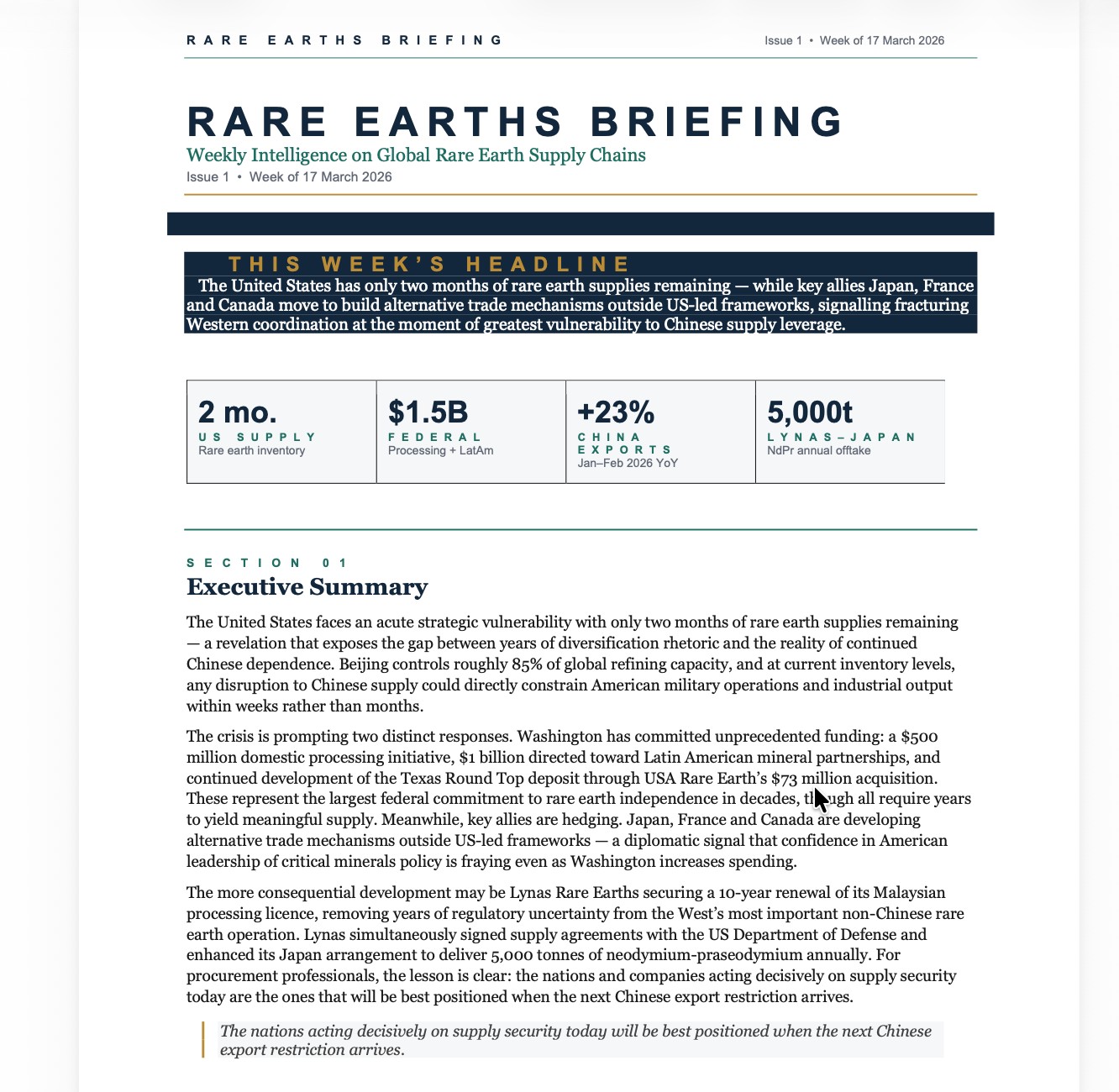
Rare Earths Briefing is one of our own systems — built to prove out a specific pattern of work. When a market is opaque, fragmented, and consequential enough that decisions turn on knowing what happened this week, someone somewhere is doing the reading by hand. That someone is usually senior, expensive, and would rather be doing something else.
The rare earths market fits that description almost too well. Information is scattered across sixty or so sources in a dozen countries — Chinese trade press, US Department of Defense filings, Malaysian regulatory notices, project updates from junior miners on three continents, industry analyst commentary, government policy statements. Enterprise intelligence services covering the sector charge in the fifteen-thousand-pound-and-up range annually; the free tier of the same market gives you the headlines without the synthesis that makes them useful.
The briefing sits in the gap. Weekly, six editorial sections, a hundred hours of reading distilled into something a procurement head, a policy adviser or a fund analyst can read in twenty minutes and act on before the next meeting. Chosen deliberately as the demonstration sector because rare earths are exactly the kind of market where information opacity translates into commercial value for whoever chooses to synthesise it.
What sits underneath
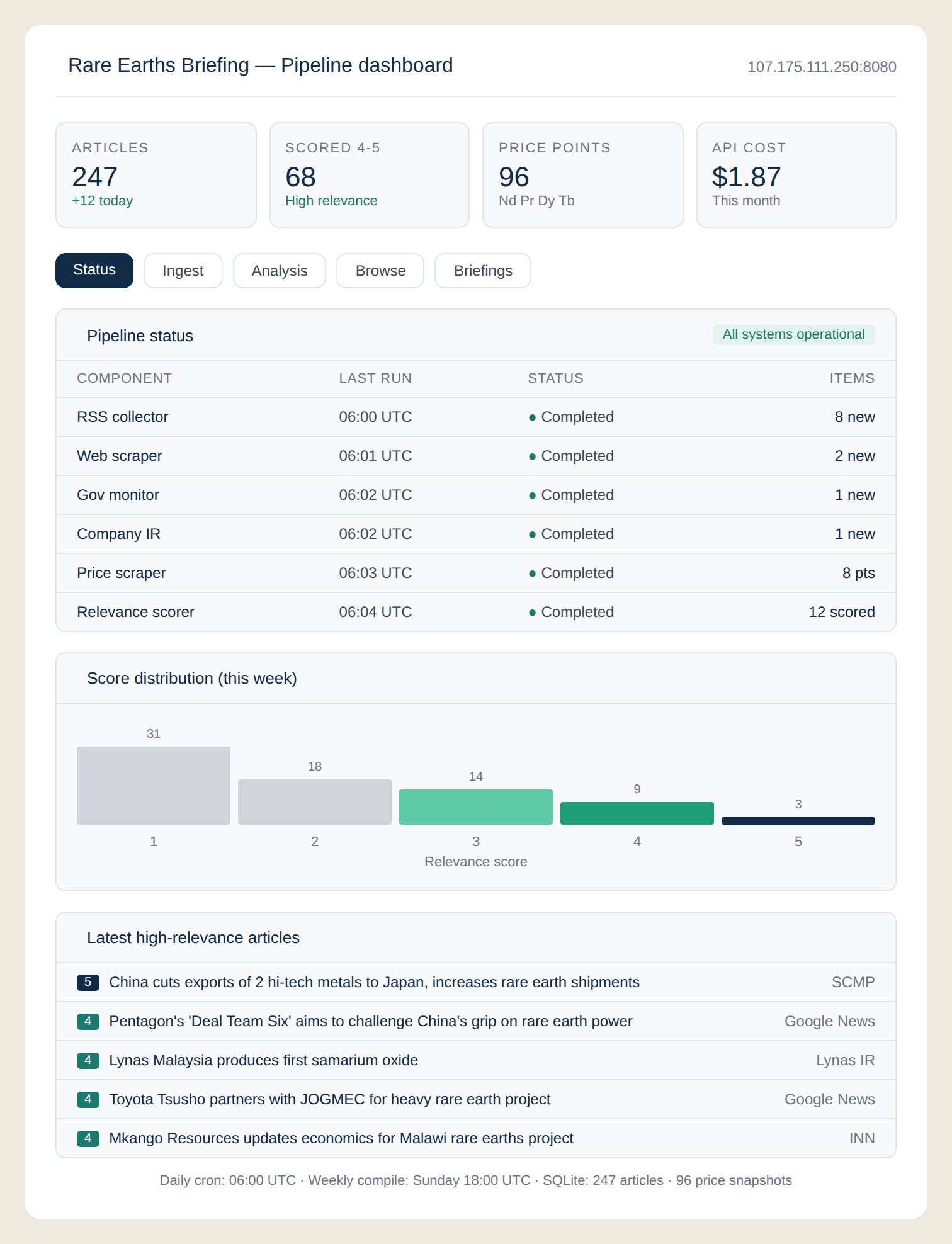
An automated ingestion pipeline, running as a daily cron job on a single VPS, collects new material from RSS feeds, targeted web scrapes, government monitoring endpoints, and company investor-relations pages. Keyword filtering at the ingestion layer — before anything is stored, before anything is scored — reduces the raw signal from terabytes to gigabytes, and from gigabytes to a working set measured in megabytes. That filter is where most of the engineering value lives, because it decides what the rest of the pipeline never has to look at.
Everything that survives the filter is written to a SQLite database and scored for relevance on a one-to-five scale. This is the one part of the system where we use a large language model directly: Claude is called through the API to read each article and assign a score, using a briefing-specific rubric. The cost of doing so runs to roughly two dollars a month at current volumes — several orders of magnitude below what a human analyst would cost for the same reading load, and, in our testing, more consistent than a tired analyst at 6pm on a Thursday.
Once a week, the highest-scoring material is compiled into a six-section briefing following a fixed editorial structure: executive summary, headline development, policy movements, market activity, corporate developments, and outlook. The output is a branded PDF and web edition. The whole pipeline — ingestion, scoring, weekly compilation, delivery — runs unattended.
Why it sits in this portfolio
Because it demonstrates the commercial intelligence briefing pattern in full. Ingest, score, synthesise, deliver, on a schedule, at a cost of pennies rather than pounds. The same shape of system can be pointed at almost any market where a decision-maker needs to know what happened this week and doesn’t have time to find out for themselves.
The rare earths sector was the demonstration; the pattern is what After the Rain builds for clients whose own markets have the same shape.